
Why AI Governance Can’t Wait
AI reached most companies before the policy did. Employees already use it to draft emails, summarize contracts, analyze data, and write code. Some of those tools were approved. Many were not, and in a lot of organizations nobody can say which is which.
That gap is the real exposure. AI is not the problem by itself. Unmanaged use is. A customer list pasted into a public chatbot, a financial model built on an answer no one checked, or a hiring decision that leans on a tool no one reviewed for bias can each happen quietly, with good intentions, and still cause legal, financial, and reputational damage.
Most leaders sense the risk. Few can say how large it is. Closing the distance between “we think there is a risk” and “we know what it is” is where AI governance starts.
The Standards You Can Build On
You do not have to invent a framework. Four reference points now define what good looks like:
- NIST AI Risk Management Framework (AI RMF 1.0). A voluntary U.S. framework released in 2023 and built on four functions: Govern, Map, Measure, and Manage. NIST added a Generative AI Profile (NIST AI 600-1) in 2024.
- ISO/IEC 42001:2023. The first international standard for an AI management system. Accredited auditors can certify against it, and customers and partners are starting to ask vendors to show it.
- ISO/IEC 23894:2023. International guidance on AI risk management, built on ISO 31000. It ties AI risk to the enterprise risk process many companies already run.
- EU AI Act. In force since August 2024. Bans on certain AI uses and rules for general-purpose AI already apply. Amendments adopted in June 2026 and now in force push most high-risk obligations to December 2027, and to August 2028 for AI built into regulated products. The Act reaches any company whose AI touches the European market.
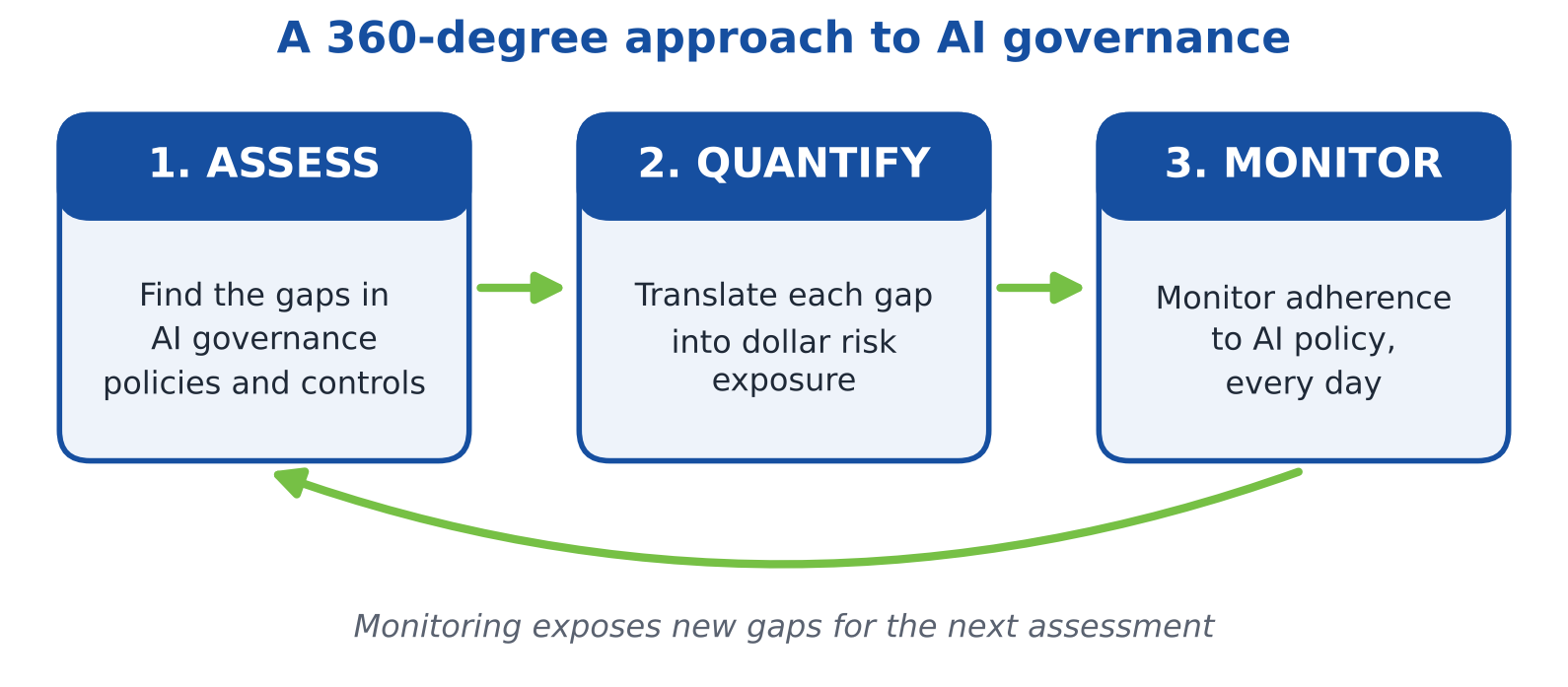
These standards agree on the basics: know where AI is used, set clear rules, measure the risk, and keep watching. What they cannot do is tell you where your own gaps are or what those gaps could cost. That work belongs to each organization, and it takes three steps.
Step 1: Find the Gaps
Start with an honest look at what you have. A real AI governance and controls assessment goes well beyond a quick checklist. Measure your program against a recognized yardstick, such as the Govern and Map functions of the NIST AI RMF or the requirements of ISO/IEC 42001, and ask questions like these:
- Do we have an acceptable use policy for AI, and do employees know it exists?
- Which AI tools are approved, and who decides?
- What data must never leave the company through an AI tool?
- Who reviews AI output before it drives a decision that affects customers, employees, or financial results?
- How do we handle AI that is built into software we already buy from vendors?
Many organizations find their policies were written before AI was part of daily work. Others find a policy on paper with no procedure behind it. Either way, the assessment shows leadership where they stand today and what is missing.
Step 2: Turn Each Gap Into Dollars of Risk
A gap is not yet a number. A missing data handling rule, an approved tool list nobody maintains, and no human review of AI output are each a door left open. Next, connect every gap to the specific loss event it allows, and answer the question every board eventually asks: how big is this?
Too often the answer arrives as a color. AI risk is “red.” Data leakage is “4 out of 5.” Ratings like these feel like answers, but a red on one risk and a red on another can mean very different things. A board cannot budget a color, and a CFO cannot weigh a “4” against any other investment.
This is where many AI programs quietly fall short. The NIST Measure function and ISO/IEC 42001 both call for assessing AI risk, yet leave the method to you. A heat map can check the box. Only dollars give leadership something to act on.
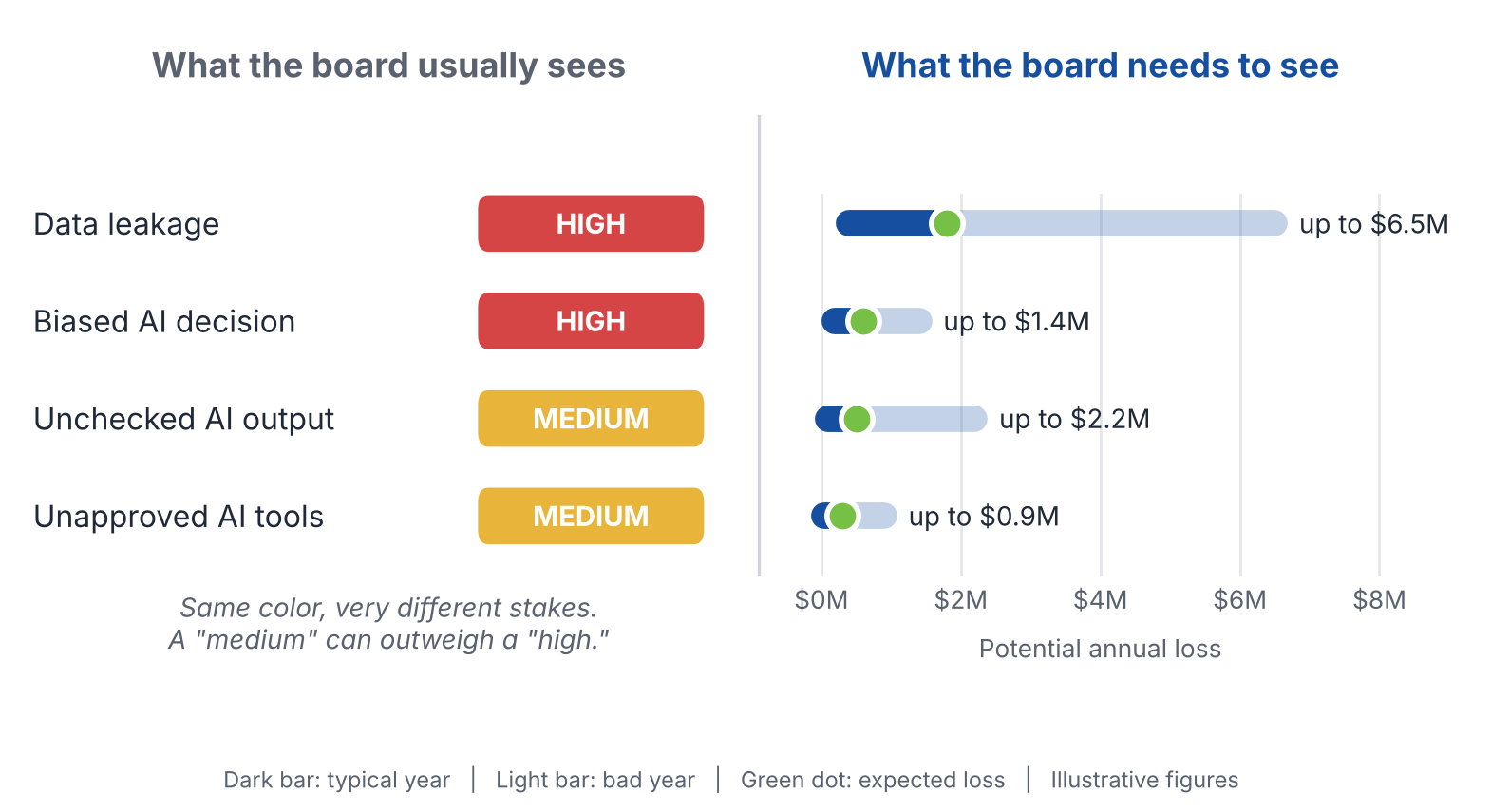
Quantify each gap as a range. If there is no rule on what data can enter an AI tool, what could a confidential data leak cost? If no one reviews AI output, what happens when a flawed answer drives a pricing, hiring, or credit decision and triggers a regulatory action or a lawsuit? Methods such as Monte Carlo simulation turn those questions into a realistic range, from a mild year to a bad one, as part of a broader cyber risk assessment.
When management sees each gap in dollars, the conversation changes. AI governance stops being a compliance chore and becomes a business decision. Leaders can see which gaps to close first, what closing them is worth, and whether the money spent on controls is paying off.
Step 3: Monitor Whether People Follow the Rules
A gap closed on paper is not closed in practice. New AI tools appear every week, and employees find workarounds. A policy nobody checks is only a suggestion.
The third step is continuous monitoring of policy adherence. Technology now exists that can run on company computers and servers and compare how AI is actually used against your own rules. It can flag or block violations, stop sensitive data before it leaves, and show where a needed policy does not exist yet. Those findings feed straight back into your next assessment.
Think of it as an AI vulnerability scan that never stops. It turns governance from a document reviewed once a year into a practice that runs every day, which is what the standards expect. The NIST Manage function and the monitoring and continual improvement requirements of ISO/IEC 42001 both assume governance never stops.
What a Complete Program Looks Like
Each step matters alone. Together they form a cycle:
- Assess your AI governance policies and controls to find the gaps.
- Quantify each gap as dollar risk exposure so leadership understands its true size.
- Monitor adherence to AI policy continuously so practice matches the rules.
The companies that get this right will not be the ones that avoid AI. They will be the ones that use it with confidence, because they know where their exposure is, what it is worth, and that someone is watching it every day.
So here is the question for every leader: if your board asked tomorrow how much AI risk your company is carrying, could you answer in dollars?
Ready to find out? Book a personalized demo with Aperitisoft™ today!